
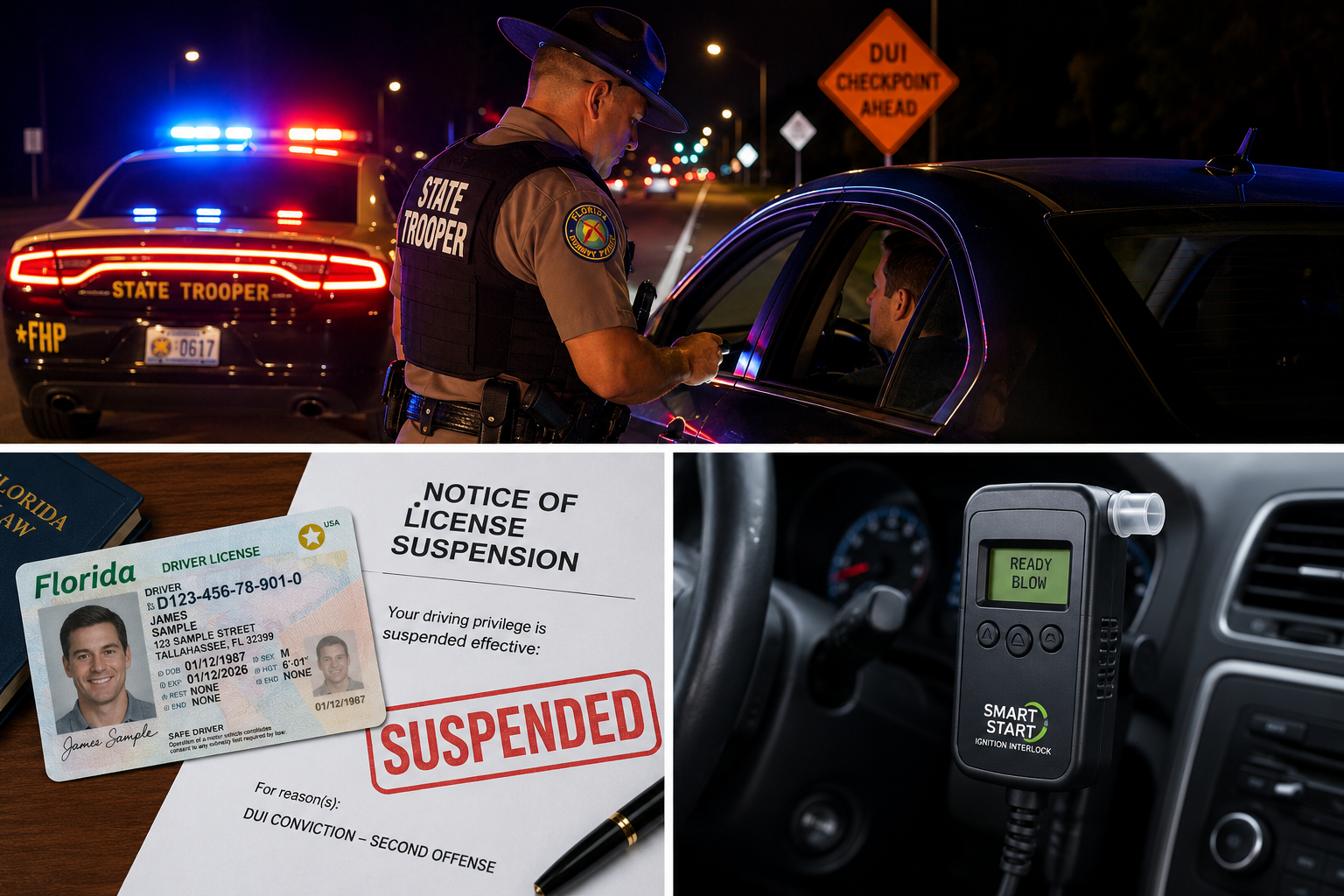
A Second DUI Conviction in the State of Florida Is: What Drivers Need to Know
Executive Summary
Driving under the influence (DUI) remains one of Florida’s most frequently prosecuted traffic-related criminal offenses. While any DUI conviction carries serious legal and financial consequences, repeat offenses result in significantly harsher penalties under Florida law.
A second DUI conviction in the state of Florida is treated more severely than a first offense, with increased fines, longer driver’s license suspensions, possible mandatory jail sentences, ignition interlock device requirements, and long-term impacts on insurance costs and employment opportunities. The exact penalties depend on several factors, including how much time has passed since the first conviction and whether aggravating circumstances were involved.
Featured Snippet
A second DUI conviction in the state of Florida is a criminal offense that carries increased penalties compared to a first DUI, including higher fines, longer driver’s license suspension, possible mandatory jail time, ignition interlock requirements, and higher insurance costs.
Key Takeaways
- Florida imposes stricter penalties for second DUI convictions.
- Mandatory jail time may apply if the second offense occurs within five years.
- License suspension periods increase.
- Ignition interlock devices are commonly required.
- Insurance costs typically rise significantly.
Table of Contents
- Understanding Florida DUI Laws
- What Counts as a Second DUI Conviction?
- Florida Statute §316.193
- Criminal Penalties
- Fines
- Jail Time
- Driver’s License Suspension
Understanding Florida DUI Laws
Florida law prohibits operating or being in actual physical control of a vehicle while impaired by alcohol, controlled substances, or certain medications. A blood alcohol concentration (BAC) of 0.08% or higher generally establishes legal impairment, although impairment may also be proven through other evidence.
Repeat DUI offenses receive enhanced penalties because lawmakers consider repeat impaired driving a greater public safety risk.
What Counts as a Second DUI Conviction?
A second DUI conviction occurs when an individual who has previously been convicted of DUI is convicted again under Florida law.
Second DUI Within Five Years
- Mandatory minimum jail sentence
- Mandatory driver’s license revocation
- Vehicle impoundment
- Ignition interlock requirement
- Enhanced probation conditions
Second DUI After Five Years
Although some mandatory penalties may not apply after five years, the offense remains serious and may still result in incarceration, higher fines, probation, and long-term consequences.

Florida Statute §316.193
Most DUI penalties are governed by Florida Statute §316.193, which outlines criminal penalties, repeat offender enhancements, license sanctions, and ignition interlock requirements.
Official resources:
Criminal Penalties for a Second DUI
The penalties depend on factors including prior convictions, BAC level, whether injuries occurred, and whether aggravating circumstances were present.
- Criminal conviction
- Probation
- Community service
- DUI education program
- Possible incarceration
- Court costs
Fines
Most second DUI convictions carry fines ranging from $1,000 to $2,000, with higher penalties possible when aggravating factors exist.
Additional expenses commonly include court fees, DUI school, ignition interlock costs, vehicle impoundment, and license reinstatement fees.
Jail Time
When the second conviction occurs within five years of the first conviction, Florida law generally requires a mandatory minimum jail sentence. Judges may impose longer sentences depending on the facts of the case.
Driver’s License Suspension
A second DUI conviction may result in a lengthy driver’s license suspension or revocation. Before driving privileges are restored, individuals may need to complete DUI school, satisfy court requirements, pay reinstatement fees, and install an ignition interlock device when required.
Ignition Interlock Device Requirements
Florida law may require many second-time DUI offenders to install an ignition interlock device (IID) before full driving privileges are restored. The device requires a breath sample before the vehicle can start and may request additional samples while the vehicle is in operation.
- Installation by an approved vendor
- Monthly monitoring and calibration
- Driver is responsible for associated costs
- Failure to comply may result in additional penalties
Insurance Consequences
A second DUI conviction can significantly increase auto insurance premiums. Some drivers may be required to obtain FR-44 insurance, which generally requires higher liability coverage than a standard policy.
- Higher insurance premiums
- Possible policy cancellation or non-renewal
- Limited insurer options
- Additional reinstatement requirements
Long-Term Impacts
Employment
A second DUI conviction may affect employment opportunities, particularly for jobs involving driving, government service, healthcare, education, or professional licensing.
Professional Licensing
Some licensing boards require license holders to report criminal convictions. Requirements vary by profession.
Travel
Some countries may impose additional entry requirements or restrictions for travelers with criminal convictions.
Criminal Record
DUI convictions generally become part of an individual’s criminal history and may appear during background checks conducted by employers, landlords, or licensing agencies.
How Florida Compares With Other States
Florida imposes enhanced penalties for repeat DUI offenses, including mandatory minimum sanctions in certain circumstances, ignition interlock requirements, license revocation, and significant financial consequences.
People Also Ask
What happens after a second DUI conviction in Florida?
Potential penalties include higher fines, mandatory jail time in some cases, driver’s license suspension, ignition interlock requirements, probation, DUI education, and increased insurance costs.
Is jail mandatory?
If the second DUI occurs within five years of the first conviction, Florida law generally requires a mandatory minimum jail sentence.
Does a second DUI stay on your record?
A DUI conviction generally becomes part of a person’s criminal record and may appear in future background checks.
Conclusion
Understanding a second dui conviction in the state of florida is important for anyone seeking reliable information about Florida’s impaired driving laws. Repeat DUI offenses carry substantially more serious consequences than first offenses, including higher fines, possible mandatory jail sentences, driver’s license suspension, ignition interlock requirements, and long-term financial and personal impacts.
Disclaimer
This article is for informational purposes only and does not constitute legal advice. Laws may change over time. Readers should consult the official Florida statutes and seek qualified legal counsel regarding their specific circumstances.
Official References
Suggested Internal Links
- Florida DUI Checkpoint Laws Explained
- What Happens After a First DUI in Florida?
- Florida Driver’s License Suspension Guide
- Florida Traffic Laws
Semantic SEO Keywords
Florida DUI laws, second DUI penalties Florida, Florida Statute 316.193, DUI fines, driver’s license suspension, ignition interlock device, FR-44 insurance, repeat DUI offense, DUI education program, Florida Highway Safety.